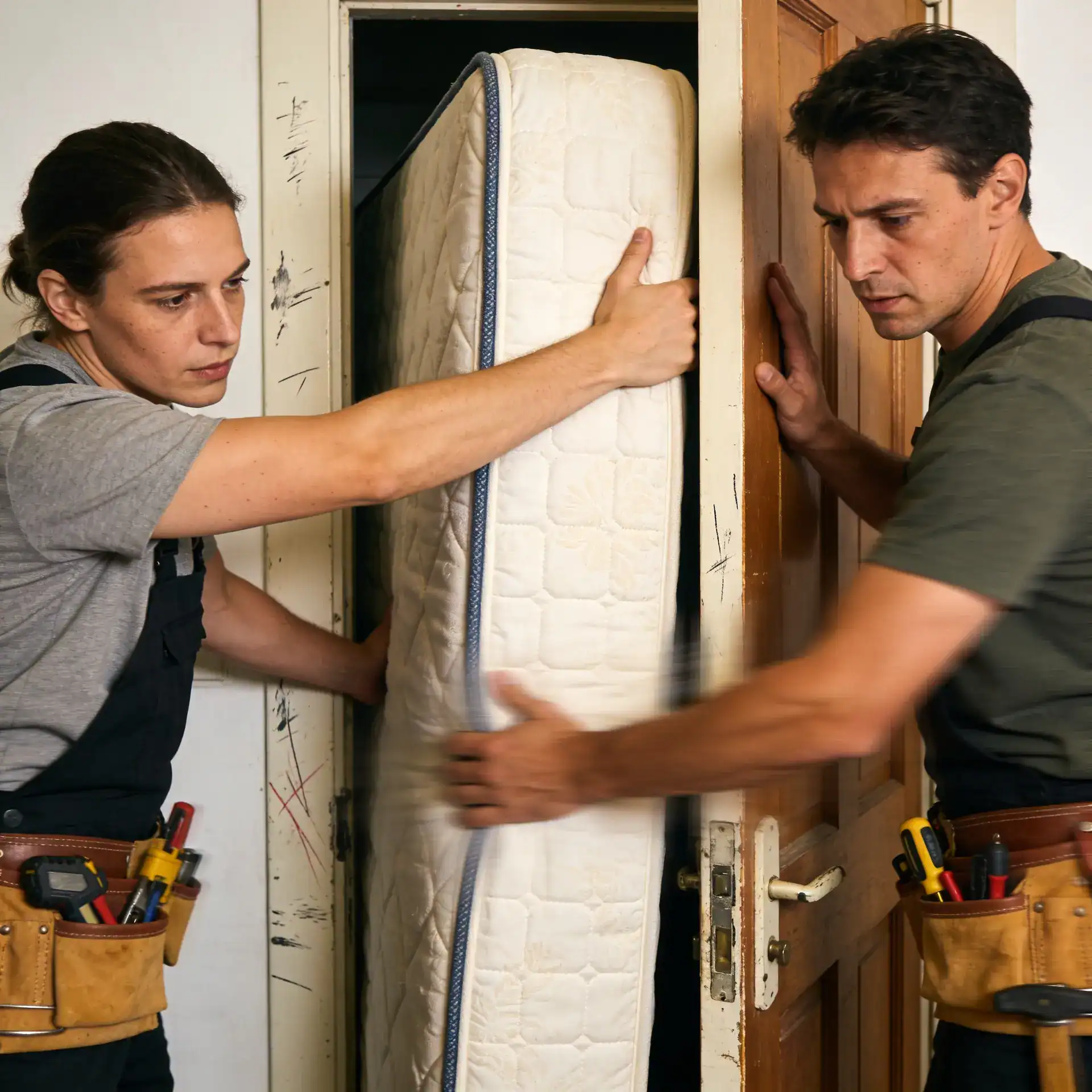
A mattress is among the most mechanically vulnerable items in a home during a move. Its size makes it difficult to navigate through standard residential architecture. Its internal construction — whether Bonnell coil, pocketed coil, viscoelastic foam, Dunlop latex, Talalay latex, or hybrid — determines which positions are structurally safe during transport, what protective materials are required, and how long the mattress needs to recover after arrival. Most mattress damage during a move is not caused by impact. It is caused by sustained incorrect loading position, moisture intrusion through an unprotected cover, and contact with door frames, stair railings, and wall corners during the carry.
Construction Type Determines Every Handling Decision
Innerspring mattresses use a tempered steel coil support system — either Bonnell, offset, continuous wire, or individually wrapped pocketed coils — calibrated to compress vertically under distributed body weight. Lateral bending stress falls entirely outside the designed tolerance of any coil system. A queen innerspring bent around a stairwell landing transfers asymmetric tension across the coil border wire, which can permanently deform the perimeter support and create an uneven sleep surface that no amount of use will correct. Innerspring and hybrid mattresses must always be transported flat or upright on their side — never bent, folded, or cantilevered over an edge.
Memory foam mattresses are composed of open-cell viscoelastic polyurethane foam, which deforms under load and recovers when pressure is removed — but only within a normal cyclic use pattern. Sustained unidirectional load during vertical transport, where gravity acts continuously on the foam mass without periodic relief, causes the cell walls in the lower foam layers to compact beyond their normal compression range. On long-distance moves exceeding two to three hours of transit time, memory foam mattresses should be transported flat. Vertical positioning is acceptable for short local moves where transit time is under 30 minutes, but the mattress should be returned to horizontal as quickly as possible after unloading.
Latex mattresses — whether Dunlop or Talalay process — are the densest and heaviest construction category. Dunlop latex, produced by pouring liquid latex into a mold in a single pour, is denser and heavier than Talalay latex, which is produced by filling a mold partially and then vacuum-expanding the material. A queen Dunlop latex mattress can exceed 130 pounds. Both latex types are naturally resistant to mold and dust mites under normal conditions, but moisture intrusion during an unprotected move compromises the cover material and can reach the latex core. Bag latex mattresses before any other handling step.
Hybrid mattresses combine a pocketed coil support base with comfort layers of memory foam, latex, or polyfoam. They carry the structural constraints of both their coil system (no bending) and their foam layers (minimize sustained vertical loading), making flat transport the safest position across all move distances.
Air chamber mattresses, including Sleep Number models, must have the air chambers fully deflated and the pump, remote, and hose components removed and packed separately before the mattress is moved. Transporting an inflated air chamber mattress creates pressure stress at the valve fittings and chamber seams when the mattress flexes during loading and unloading.
Weight by Size and the Two-Person Rule
Mattress weight varies significantly by construction type and size. A twin innerspring runs 40 to 50 pounds. A full averages 50 to 60 pounds. A queen innerspring ranges from 60 to 100 pounds, while a queen memory foam or latex mattress can reach 130 pounds. A king mattress in any construction type typically ranges from 130 to 180 pounds. A California king, at 72 by 84 inches, is narrower than a standard king but longer, which creates a different set of stairwell and doorway constraints.
Any mattress above 50 pounds requires two people. A single person carrying a queen or king mattress cannot simultaneously control the leading edge, manage the 90-degree pivot at a stairwell landing, and maintain consistent grip on a surface with no rigid handles. Shoulder moving straps — harness-style lifting systems that distribute the load across both operators’ shoulders and free their hands for steering — are the correct equipment for two-person mattress carries through tight interior spaces. Furniture sliders placed under a flat mattress allow it to be moved across hard floors without lifting, which reduces injury risk and eliminates floor scuff damage on hardwood and tile surfaces.
Spatial Measurement Before Moving Day
Standard interior door frames in Oregon homes measure 80 inches in height and 32 to 36 inches in clear width. A queen mattress at 60 inches wide moves through most door frames when rotated on its side. A king mattress at 76 inches wide requires diagonal angling through a standard door frame and needs two people to execute cleanly without contact with the frame edges. A California king at 72 inches wide presents the same challenge through narrow openings but adds complexity on staircases because its 84-inch length exceeds most stairwell widths at the landing turn.
Measure the stairwell ceiling height at the lowest point of the turn before moving day — not the straight run, but specifically the landing where the ceiling drops and the mattress must pivot. Attach adhesive foam corner guards or fold moving blankets over door frame corners, stair newel posts, and wall corners along the carry path. These contact points are where most wall and paint damage occurs, and the damage happens even on slow controlled carries because the weight of the mattress transfers significant lateral force to any surface the cover contacts.
Protective Wrapping: Materials and Application Method
A mattress bag is a polyethylene cover manufactured to match standard mattress dimensions, including profile depth. A typical mattress ranges from 8 to 14 inches in profile depth — measure yours before purchasing a bag to ensure the cover fits without excess material that bunches and tears during the carry. Mattress bags cost between $5 and $15 and protect against moisture intrusion, dust, surface abrasion, and contact soiling during loading, transit, and unloading.
Seal the bag at both ends with packing tape, then run a lengthwise and widthwise cross-pattern of tape across the full surface to prevent the bag from tearing at the seams during the carry. For memory foam and latex mattresses that lack the structural rigidity of an innerspring core, sandwich the bagged mattress between two large flattened cardboard panels on both faces and tape the assembly together before moving. This creates a handling panel that makes the mattress easier to grip, protects the bag from punctures during loading, and adds enough rigidity to allow the appliance dolly to engage the mattress edge without the foam compressing around the dolly plate.
Loading Position, Truck Placement, and Ratchet Strap Protocol
The correct loading position for innerspring and hybrid mattresses on a moving truck is upright on the side, positioned flush against the truck wall, with ratchet straps run through the truck’s tie-down rail system at two points — one at mid-height and one at the upper third of the mattress. This position conserves floor space and prevents lateral tipping during braking and turns.
Memory foam and latex mattresses on moves over 30 minutes of transit time should be loaded flat. Place these mattresses last on the truck so they sit on top of other items without anything stacked above them. Placing any object — even a lightweight box — on top of a foam mattress for several hours of transit creates a localized compression zone that can take 24 to 48 hours to recover and may not fully recover if the foam density is below 4 pounds per cubic foot.
Never transport a mattress on the roof of a car without a proper roof rack with anchor points. Aerodynamic lift at highway speeds generates significant upward force on a flat panel surface, and improvised rope systems routed through car windows fail at highway speeds with enough frequency to present a serious road safety hazard.
Post-Move Recovery and Setup Protocol
Memory foam mattresses require 24 to 48 hours of decompression time after transport before they reach their rated support profile. During this window, the foam is recovering from transit compression and thermal equalization — particularly if the mattress was transported in a cold moving truck, where lower temperatures temporarily stiffen viscoelastic foam and slow cell wall recovery. Set up the bed frame and place the mattress flat in the bedroom immediately after unloading. Do not sleep on a memory foam mattress during the re-expansion period if it was compressed or rolled for transport.
Inspect the mattress bag for moisture before removing it. Any condensation on the interior surface of the bag indicates the mattress was exposed to a temperature differential during transport. Allow the mattress to reach room temperature before removing the bag and before placing bedding on the surface.
When Replacement Is More Rational Than Transport
A mattress over eight years old that shows visible surface sag, persistent body impressions, coil protrusion, or odor is unlikely to justify the labor, materials, and truck space required to move it. The retail cost of an entry-level queen innerspring or foam mattress — typically $200 to $600 — may be less than the combined cost of a mattress bag, professional labor, and the truck space occupied during a cross-town or long-distance move.
Check the manufacturer warranty documentation before the move. Some warranties contain clauses that void coverage if the mattress sustains physical damage during transport without professional packing, or if it is moved in a manner inconsistent with the manufacturer’s handling guidelines.
If you are managing a full residential move with multiple bedrooms, oversized furniture, and specialty items, a professional crew brings shoulder straps, furniture sliders, ratchet strap systems, and the spatial experience to navigate tight Oregon home interiors without contact damage to walls, floors, or the mattress itself.
For homeowners planning a local move in the Portland or West Linn area, Redefyne Moving & Storage supplies all protective materials and handles loading sequencing so your mattress and the rest of your home arrive in the same condition they left. Get in touch for a free quote.