Piano Type Determines Every Equipment and Handling Decision
Upright pianos and grand pianos are structurally opposite instruments, and they require entirely different moving approaches. Understanding the internal architecture of each type is the prerequisite for making correct decisions about equipment, crew size, spatial routing, and transport position.
An upright piano houses its strings and soundboard vertically within a rectangular cabinet. The strings run from top to bottom, the soundboard spans the rear interior of the cabinet, and the action mechanism — the hammer and damper assembly that translates key presses into sound — is positioned behind the keys in a vertical plane. This vertical string orientation means the piano can be moved upright on a four-wheel piano dolly without altering the relationship between the strings and the soundboard. The primary structural risk during an upright piano move is lateral impact to the cabinet, which can crack the soundboard or shift the action mechanism. The secondary risk is tipping, which transfers the instrument’s full weight to the legs or casters — components not designed to bear lateral load.
A grand piano or baby grand piano orients its strings and soundboard horizontally. The soundboard is the large curved wooden panel that forms the floor of the instrument’s resonating cavity. The strings run away from the keyboard toward the tail of the piano in a horizontal fan arrangement. The instrument is supported by three legs — two at the wide end near the keyboard and one at the narrow tail end. These legs are not structural load-bearing components in the engineering sense; they position the instrument at playing height but are not designed to bear the lateral forces of a move. Before a grand or baby grand piano can be moved any meaningful distance, the three legs and the pedal lyre assembly must be removed. The legless piano body is then placed on a piano skid board — a padded plywood platform with integral strap divots — and transported in this position with the keyboard side facing up.
The distinction matters because attempting to move a grand piano without removing the legs is one of the most common causes of catastrophic leg fracture during residential moves. The legs attach to the cabinet via a mortise joint secured by a single bolt. Under lateral movement load, this joint is not designed to resist shear force from a direction other than vertical. A grand piano dolly rolled across an uneven threshold or a parking apron with all three legs attached can generate enough lateral force at the leg attachment point to fracture the joint or split the cabinet at the leg socket.
Weight, Crew Size, and the Mechanical Requirements of Each
Piano weight varies significantly by instrument type, manufacturer, and age. Console pianos — the smallest upright variant, typically 40 to 43 inches tall — weigh 300 to 400 pounds. Studio uprights at 45 to 48 inches tall weigh 400 to 500 pounds. Full upright or professional upright pianos at 50 to 60 inches tall weigh 500 to 800 pounds. Baby grand pianos, ranging from 4 feet 11 inches to 5 feet 6 inches in length, weigh 500 to 650 pounds. Mid-size grand pianos from 5 feet 7 inches to 6 feet weigh 650 to 800 pounds. Concert grand pianos at 7 feet and above — Steinway Model D, Yamaha CFX, Bösendorfer Imperial — weigh 900 to 1,200 pounds or more.
Crew size requirements follow directly from these weights and the spatial constraints of the specific move. A console or studio upright on a single-level move with clear hallway access requires a minimum of three people. A full upright requires four. Any upright piano navigating a staircase requires a minimum of four people and ideally five, with specific role assignments: two on the dolly, one at each corner for stability, and one spotting the path. A baby grand or mid-size grand with leg removal on a single-level move requires four people minimum. Any grand piano on a staircase requires five to six people. A concert grand on a staircase requires six people and in some configurations professional hoisting equipment.
These crew sizes are not conservative estimates. They reflect the actual mechanical requirements of controlling an instrument of this mass through a residential stairwell, where the person at the lower end of the carry bears the majority of the load and must simultaneously control speed, angle, and direction through a sequence of steps without being able to see the path clearly. Insufficient crew size on a piano staircase move does not produce a slower move — it produces a loss of control event.
Equipment: What Each Piano Type Requires
A four-wheel piano dolly with rubber casters is the standard transport equipment for upright pianos. The four-wheel configuration distributes the piano’s weight across a wider base than a standard two-wheel hand truck, which prevents the instrument from tipping during turns. Rubber casters protect hardwood and tile floors from marking and provide grip on smooth surfaces. The dolly must be rated for the specific piano’s weight — not all piano dollies are rated equally, and using an undersized dolly risks dolly failure under load. Confirm the dolly’s weight rating before the move.
A piano skid board — also called a piano board or piano moving board — is the required transport platform for grand and baby grand pianos once the legs are removed. A piano skid board is a padded rectangular platform, typically constructed from layered plywood with carpet or foam padding on the contact surface and integral strap divots along the sides. The legless grand piano body is lowered onto the skid board with the keyboard side up, secured with heavy-duty ratchet straps through the divots, and moved on the board using a combination of lifting and controlled sliding depending on the surface and obstacle type. Piano skid boards are available for purchase or rental from piano-specific moving suppliers. A standard furniture dolly is not a substitute — it does not provide the edge support, padding, or strap attachment points required for a grand piano body.
Heavy-duty moving blankets — minimum four per piano — protect the exterior cabinet finish from contact damage during loading and transport. Wrap the entire piano body before moving it onto the dolly or skid board. Secure the blankets with packing tape applied only to tape-on-tape contact points, never directly to the piano finish, which can lift lacquer or veneer on removal. Ratchet straps, not rope, are the correct fastener for securing the piano to the dolly, to the skid board, and to the truck tie-down rails. Rope stretches under load and allows movement that ratchet straps do not.
A piano with casters — small rubber or brass wheels at the base of the legs, present on many upright models — should have the casters locked before moving, if lockable, or removed entirely if the move involves any surface transition that could allow the piano to roll. A piano that begins rolling on a ramp or threshold is not recoverable by hand once it builds momentum.
Spatial Measurement and Path Planning Before Moving Day
Measure every spatial constraint before the move — not during it. The relevant measurements are the piano’s height, width, depth, and for grand pianos, the lid clearance height when the lid is open on the skid board. The relevant architectural measurements are doorway clear width (frame to frame, not rough opening), hallway clear width, stairwell width, stairwell ceiling height at the lowest point of the turn (the landing), and the clear height of any exterior door, garage door, or building entrance the piano must pass through.
Standard interior door frames in Oregon homes measure 80 inches tall and 32 to 36 inches in clear width. A full upright piano is typically 58 to 62 inches wide — wider than the door frame in most configurations. Moving an upright piano through a standard interior doorway requires rotating it so that the narrow dimension (depth, typically 24 to 30 inches) faces the doorway and carrying it through at an angle. This rotation requires coordinated lifting rather than dolly rolling through the doorway, because the dolly configuration prevents the diagonal angle that fits through the frame.
For staircases, measure the ceiling height at the stairwell landing specifically. This is not the ceiling height on the straight run of the stairs — it is the ceiling height at the point where the piano must pivot to change direction from one flight to the next. This measurement is the most frequently underestimated spatial constraint in piano staircase moves and is where the majority of ceiling and piano damage occurs. Any ceiling height below 84 inches at a stairwell landing creates significant difficulty for an upright piano move and may require partial disassembly of the piano cabinet or alternative access routing.
Alternative access routes — windows, exterior balconies, roof hoisting — are legitimate solutions for pianos that cannot be navigated through a standard residential interior path. A window removal and exterior hoist is a documented, specialist-level technique used when stairwell access is impossible. If your new home has a piano room on an upper floor and the stairwell measurements are marginal, identify the alternative access route before moving day rather than discovering the problem after the crew arrives.
Grand Piano Disassembly: Sequence and Technique
The disassembly sequence for a baby grand or grand piano follows a fixed order. Deviation from the sequence risks structural damage at each step.
Begin with the music rack — the stand that holds sheet music above the keys. On most grand pianos, the music rack lifts out of its track by pulling it toward the keyboard. Wrap it in a moving blanket and set it aside. Next, remove the lid. The lid is hinged to the piano body at two points along the straight side. The lid prop rod must be removed and stored first. With one person holding the lid steady opposite the hinge while a second person works the hinge pins loose, the lid separates from the body. Grand piano lids are large, heavy, and finished on both sides — lay the removed lid flat on a padded surface and transport it in that orientation.
The pedal lyre — the vertical assembly that houses the three pedals and connects them to the internal action mechanism via metal rods — is the next component to remove. The lyre attaches to the underside of the piano body at two points and to the floor block at the base. Remove the floor block screws first, then the lyre attachment bolts. Label all hardware in a zip-lock bag and tape it to the lyre assembly. Wrap the lyre in a moving blanket and transport it separately.
Leg removal follows. Each leg attaches at a flat plate mounted to the underside of the piano cabinet via a key-and-slot joint secured by a single leg bolt. To remove a leg, have one person hold the leg steady while a second person removes the leg bolt with a socket wrench. Once the bolt is out, slide the leg toward the center of the piano until it clears the slot, then lower it. Grand piano legs are finished wooden components — lay them flat on blankets and do not stack them.
Remove the two front legs first while the piano remains supported on the third rear leg and the keyboard fallboard edge resting on a padded surface. Position the skid board beside the piano before removing the final leg. Lower the legless piano body onto the skid board as a controlled team movement — not a drop — with the keyboard side up and the straight edge against the skid board brace. Secure with ratchet straps through the divots before moving.
Navigating Stairs: Technique and Safety Protocol
Staircase moves for both upright and grand pianos require controlled speed above all other variables. The staircase is not where pianos are lost to impact damage — it is where control is lost to speed. A piano on a staircase that begins moving faster than the crew can manage is not recoverable.
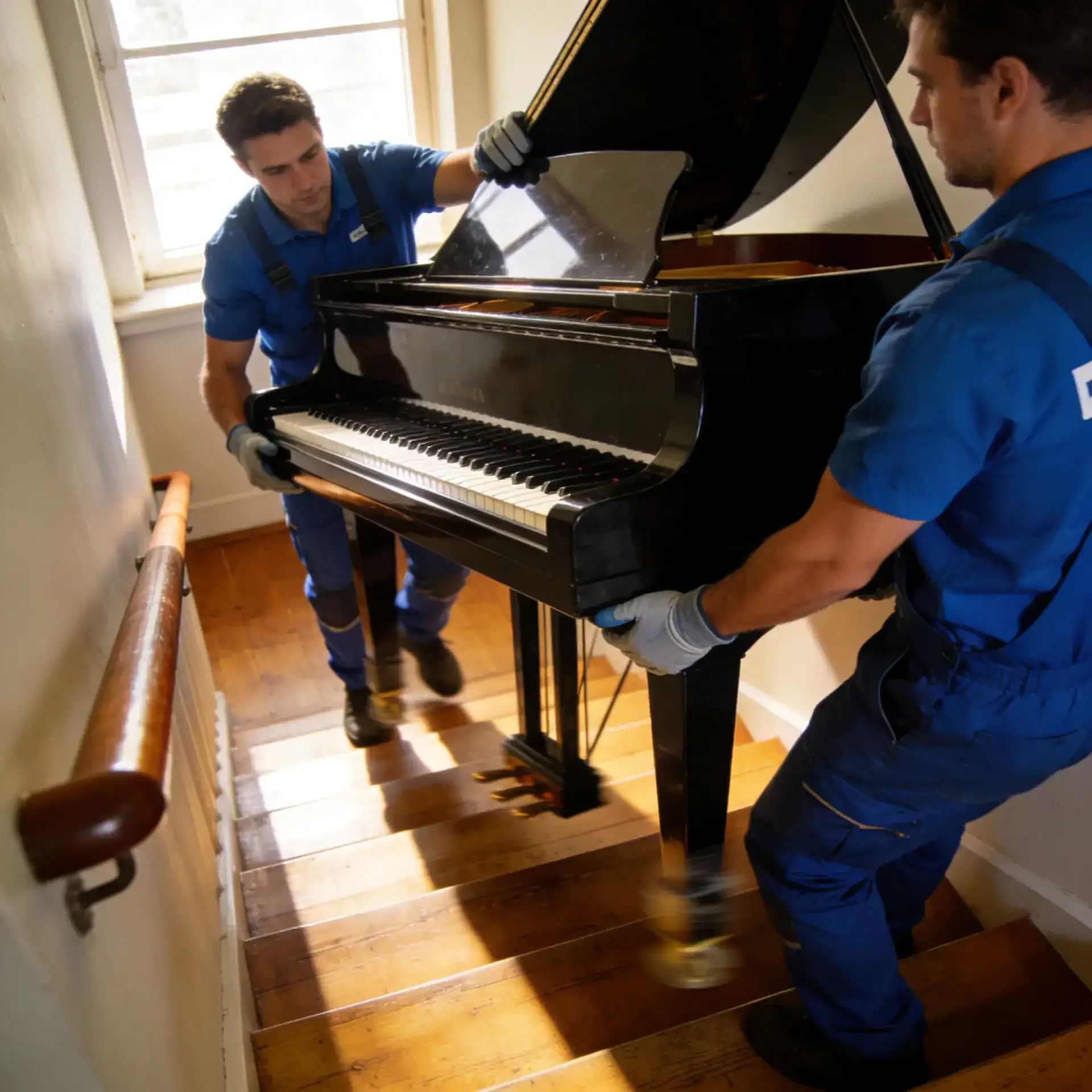
For upright pianos on a staircase, use the dolly as a stair skid rather than attempting to carry the piano suspended. Position the dolly with the piano secured in place, tip the piano back slightly onto the two dolly wheels, and walk the dolly down the staircase one step at a time with two people controlling the descent from above and two spotting from below. The person at the lower end bears the load during descent and must maintain footing — use non-slip footwear and confirm the staircase surface is dry and clear of obstacles before beginning the descent. A hump strap — a loop strap attached to the upper end of the dolly — distributes the holding load across the upper crew members’ shoulders and prevents the strain of holding a 500-pound instrument by arm strength alone.
For grand piano bodies on a skid board, the skid board itself functions as the stair skid. Position the keyboard end toward the bottom of the stairs. Attach a hump strap to the upper end of the skid board to prevent acceleration. Move one step at a time with clear verbal communication between the upper and lower crew members at each step. Never allow the piano to travel more than one step ahead of the crew’s controlled position.
Pad the staircase wall, the stair railing, and any corner surfaces along the path with moving blankets secured with tape before beginning the descent. Piano cabinet corners and the skid board edges are the primary contact points on stair moves, and any wall surface within 12 inches of the piano’s path will be contacted at some point during a staircase move regardless of how carefully the crew navigates.
Loading, Truck Placement, and Transport Position
The piano should be the first item loaded onto the moving truck and positioned against the cab wall — the forward wall of the cargo area. This position provides two structural benefits: the cab wall acts as a rigid brace that prevents the piano from tipping forward during braking, and loading the piano first ensures it can be positioned without negotiating around other cargo.
Upright pianos must be transported upright — never on their back or side. The strings and soundboard are designed to function and bear load in the vertical orientation. Transporting an upright piano on its back places the full weight of the internal iron plate — which can weigh 300 to 400 pounds alone — against the soundboard from a direction it is not designed to bear, risking soundboard cracking or separation from the cabinet.
Grand piano bodies on a skid board are transported on their side — keyboard up — which is the position they were placed in for the staircase carry. This is the correct transport orientation for a grand piano on a skid board. Secure the piano to the truck’s tie-down rails with ratchet straps at two points: one across the mid-section and one across the upper third of the piano. Verify that the straps do not contact the keyboard fallboard or any finished surface without an intervening moving blanket.
Drive conservatively. Hard braking generates forward momentum in the cargo load that the ratchet straps must absorb. Sharp turns generate lateral load. On Portland-area roads, the combination of pavement irregularities, MAX rail crossings, and bridge expansion joints creates a vibration profile that is hard on piano strings and action components. Take the smoothest available route between origin and destination, even if it adds distance.
Climate, Humidity, and the Pacific Northwest Specific Risk
The Pacific Northwest’s climate presents a specific risk for piano transport that is not present in drier regions. Portland averages 37 inches of annual rainfall with ambient relative humidity between 75 and 85 percent in winter months. Piano soundboards are manufactured from quarter-sawn Sitka spruce or Engelmann spruce — both species are highly responsive to moisture. The soundboard expands as it absorbs atmospheric moisture and contracts as it releases it. This expansion and contraction is what gives the soundboard its crown — the slight convex curvature that contributes to tonal projection — and is also what determines string tension.
When a piano is moved from a climate-controlled interior environment into a wet Pacific Northwest winter — even for the 20 to 30 minutes required to load it onto a truck — the soundboard surface begins absorbing ambient moisture from the air immediately. If the piano is then placed in an untempered moving truck for a transit period of more than 30 minutes, the sustained humidity exposure begins altering string tension in the outer string registers, which is why post-move tuning is almost always required regardless of how carefully the piano is handled physically.
The practical mitigation for Portland-area piano moves is to minimize the total time the piano spends in uncontrolled environments. Move quickly through the exterior transition from origin to truck. If the move is over an extended distance or involves a storage period, climate-controlled storage in Portland is the correct intermediate environment for a piano — not a standard self-storage unit. Standard units cycle through Portland’s ambient humidity range continuously, which subjects the soundboard and pin block to repeated expansion and contraction cycles that accelerate tuning instability and can crack the soundboard over storage periods exceeding two to three weeks.
Post-Move Placement: Where a Piano Should and Should Not Go
Piano placement in the new home is not an aesthetic decision — it is an acoustic and structural one. The placement decisions made at move-in directly determine how stable the instrument’s tuning will be in the months following the move.
Upright pianos should be placed against an interior wall, not an exterior wall. Exterior walls in Oregon homes are subject to greater thermal variation as outdoor temperatures change, which transmits temperature fluctuation to the piano through the wall contact surface. Interior walls maintain a more stable thermal environment year-round. The piano should not be placed adjacent to a heat register, fireplace, or baseboard heater. Forced-air heating is the most common environmental stressor for piano soundboards in Pacific Northwest homes — the dry heated air that flows from floor registers in winter creates localized drying conditions at the soundboard surface that cause pitch to drop and, in extreme cases, cause the soundboard to crack along the grain.
Grand pianos perform best with the straight edge — the side with the keyboard and the pin block — against an interior wall. The curved tail faces into the room. This orientation optimizes sound projection into the room’s acoustic space and minimizes the thermal variation the pin block and tuning pins are exposed to.
Neither type should be placed in direct sunlight. UV radiation degrades the lacquer finish over time, and the thermal load of direct sunlight raises the soundboard temperature locally, which creates localized expansion that distorts the crown and alters string tension in the affected register. A piano within 6 feet of a south or west-facing window in a Portland home will receive direct afternoon sunlight through most of the year — this is sufficient to produce visible finish degradation within 12 to 18 months.
Post-Move Tuning: When, Why, and What to Expect
Virtually every piano that moves between homes in the Portland area will require tuning after the move. This is not a reflection of how carefully the move was executed — it is a consequence of the humidity and temperature differential between the origin environment and the destination environment, combined with the physical stress of transport vibration on the tuning pin and pin block interface.
The tuning pins are steel shafts press-fitted into a laminated hardwood pin block. Each pin holds one string at tension by friction between the pin shaft and the pin block wood. When the pin block absorbs or releases moisture in response to humidity changes, the wood fibers at the pin interface expand or contract, which alters the friction grip on the tuning pin and allows microscopic pin rotation — which changes string tension and therefore pitch.
The correct window for post-move tuning is two to four weeks after the move. Tuning within 48 hours of arrival is not recommended because the piano is still acclimating to the new environment’s humidity level and the tuning will not hold. Tuning at two to four weeks allows the soundboard and pin block to reach equilibrium with the new environment so the tuning has a stable baseline to be set against. If the piano has not been tuned in more than a year before the move — which is common — the first post-move service may require a pitch raise before fine tuning. A pitch raise is a preliminary pass across all strings that brings the instrument back to A440 concert pitch before fine tuning can be applied accurately. Budget approximately $150 to $250 for a standard post-move tuning in the Portland area. A pitch raise adds $50 to $100 to this cost.
Schedule the tuning appointment before the move so the appointment is confirmed for the correct window. Portland-area piano technicians book two to four weeks out during busy periods — waiting to schedule after the move risks the tuning happening outside the optimal window.
When Professional Piano Moving Is Not Optional
The scenarios in which DIY piano moving is not a rational choice — regardless of crew availability, physical capability, or budget — are specific and identifiable. A grand or concert grand piano on any staircase. Any piano being moved through a space where the spatial measurements produce less than two inches of clearance in any dimension. Any piano with documented pre-existing structural damage to the cabinet, legs, or soundboard. Any piano valued above its replacement cost as a collectible or historical instrument. Any piano that must be hoisted through a window or exterior access point.
In each of these scenarios, the cost of a professional piano move — which ranges from approximately $250 to $600 for a local Portland-area upright piano move and $400 to $1,000 or more for a grand piano depending on access complexity — is categorically lower than the cost of repairing or replacing an instrument damaged during a DIY move that exceeded the crew’s capability.
Choosing the right moving company for a piano is a distinct decision from choosing a general household mover. Verify that the company has specific piano moving experience, carries the correct equipment — piano dollies, skid boards, hump straps — and maintains insurance coverage for specialty items. Our guide on how to choose a moving company covers the insurance and licensing verification process in detail, including what Full Value Protection covers and why Released Value Protection at $0.60 per pound is inadequate for any instrument of meaningful value.
If your upcoming move includes a piano alongside a full household, coordinating the piano move as part of a complete residential move with a crew experienced in specialty items ensures the piano is loaded first, secured correctly, and unloaded with the spatial planning the instrument requires — without the coordination overhead of managing two separate crews on the same moving day.
For homeowners planning a local move in Portland, West Linn, or the surrounding area, Redefyne Moving & Storage handles pianos with the equipment, crew sizing, and handling protocol the instrument demands. If your piano needs to go into storage before or after the move, our packing and storage services include climate-appropriate options for instruments that cannot safely sit in a standard unit through a Portland winter. Get in touch for a free quote today.