Why Antique Furniture Construction Creates Specific Moving Vulnerabilities
Furniture made before approximately 1940 was almost universally constructed using hide glue, also called animal glue or scotch glue, rendered from collagen derived from animal hides and bones. Hide glue produces an exceptionally strong bond when fresh and properly applied but becomes progressively more brittle as it ages and as it is cycled through repeated humidity swings over decades. In a well-maintained antique piece that has lived in a stable environment, hide glue joints remain structurally sound. In a piece that has been exposed to dry furnace air in winter and humidity in summer over 80 or 100 years, the glue at every joint interface has experienced thousands of cycles of expansion and contraction stress. The joint may appear solid to visual inspection — no gaps, no wobble — but the adhesive layer has degraded to a fraction of its original strength. Vibration during truck transport, lateral load during a staircase carry, or the torsional force of a piece being lifted by one leg rather than the base applies the kind of load that a fresh hide glue joint handles easily and an aged one cannot.
Mortise and tenon joints — the primary structural connection in quality antique furniture from the medieval period through the early 20th century — join two wooden components by fitting a rectangular tongue (the tenon) cut from one member into a precisely matched rectangular hole (the mortise) cut in the other. In a new piece, the tenon fills the mortise completely and the hide glue bond at the interface produces a connection that functions as a single structural unit. In an aged piece where the glue has degraded, the tenon may still fit the mortise snugly but the bond is no longer present — the joint is held by friction and gravity rather than adhesion. Lifting the piece from one component rather than supporting the full base transfers load through this degraded joint in a direction it was not designed to bear.
Dovetail joints — used primarily in drawers and cabinet corners — are the strongest traditional joinery configuration because their interlocking wedge-shaped geometry resists pulling forces mechanically rather than relying on adhesive alone. However, the drawer boxes in antique furniture are frequently the first components to loosen during aging because they experience the most repeated use stress. A drawer that slides smoothly in its case is not evidence of a structurally sound drawer box — it may indicate the joint has loosened enough to allow free movement. Packing a chest of drawers with the drawers installed and allowing them to shift during transport applies impact load to loose dovetail joints with every road irregularity the truck encounters.
Veneer presents a separate category of vulnerability. Veneered surfaces on antique furniture were applied with hide glue over a solid wood substrate, typically a secondary wood like poplar, pine, or oak. As the substrate wood expands and contracts with humidity changes, the veneer layer moves differently because it is cut from a different grain orientation or a different wood species entirely. Over decades, this differential movement causes the hide glue bond between veneer and substrate to release in localized areas, creating bubbles, lifting edges, and hairline separations that are invisible until contact or moisture causes the veneer to detach entirely. Packing tape applied directly to a veneered surface, plastic wrap sealed against a veneer edge, or a damp moving blanket held in contact with a veneer surface for hours during transport can all trigger veneer release at these weakened bond points.
Documentation and Appraisal Before Packing Begins
Photograph every piece from every angle before packing begins. This documentation serves two functions: it establishes the pre-move condition of each item for insurance purposes, and it creates a reference for reassembly of any disassembled components. For each piece, photograph the overall form, every surface in detail, every existing damage point — chips, scratches, veneer lifts, joint separations, hardware losses — and all hardware in situ. Use a neutral background and consistent lighting so that finishes and surface conditions are accurately captured rather than obscured by shadows or reflections.
For pieces with meaningful monetary value — antique furniture from significant makers, period pieces from identifiable style movements, family heirlooms with documented provenance — obtain a written appraisal from a credentialed appraiser before the move. The American Society of Appraisers and the Appraisers Association of America both maintain directories of credentialed furniture and decorative arts appraisers. The appraisal serves the insurance function: most moving company valuation coverage, including Full Value Protection, calculates reimbursement at current market replacement value, which for an antique piece with no contemporary equivalent means what a comparable piece would sell for at auction or through a dealer. Without a professional appraisal establishing that value in writing before the move, any claim for a damaged or lost antique is subject to the moving company’s own valuation — which will not reflect auction market pricing for period furniture.
Create a written inventory of every piece being moved, including dimensions, material, approximate period, and condition notes. Number each piece on the inventory and use the same number on the packing materials — a small piece of masking tape on the interior surface of the packaging, never on the piece itself. This inventory becomes the check-in document at the destination.
Material Selection: What Contacts the Surface Determines the Outcome
The first material to contact any antique surface must be chemically inert and non-abrasive. This eliminates newspaper, which transfers ink to porous wood finishes and damp environments accelerate the transfer. It eliminates standard moving blankets as a first layer against finished surfaces, because the synthetic fibers in most moving blankets are abrasive enough to mark lacquer and shellac finishes under the sustained pressure of being wrapped and strapped for hours. It eliminates plastic stretch wrap applied directly to wood, which traps moisture against the surface and can react with shellac and oil finishes over the transit period.
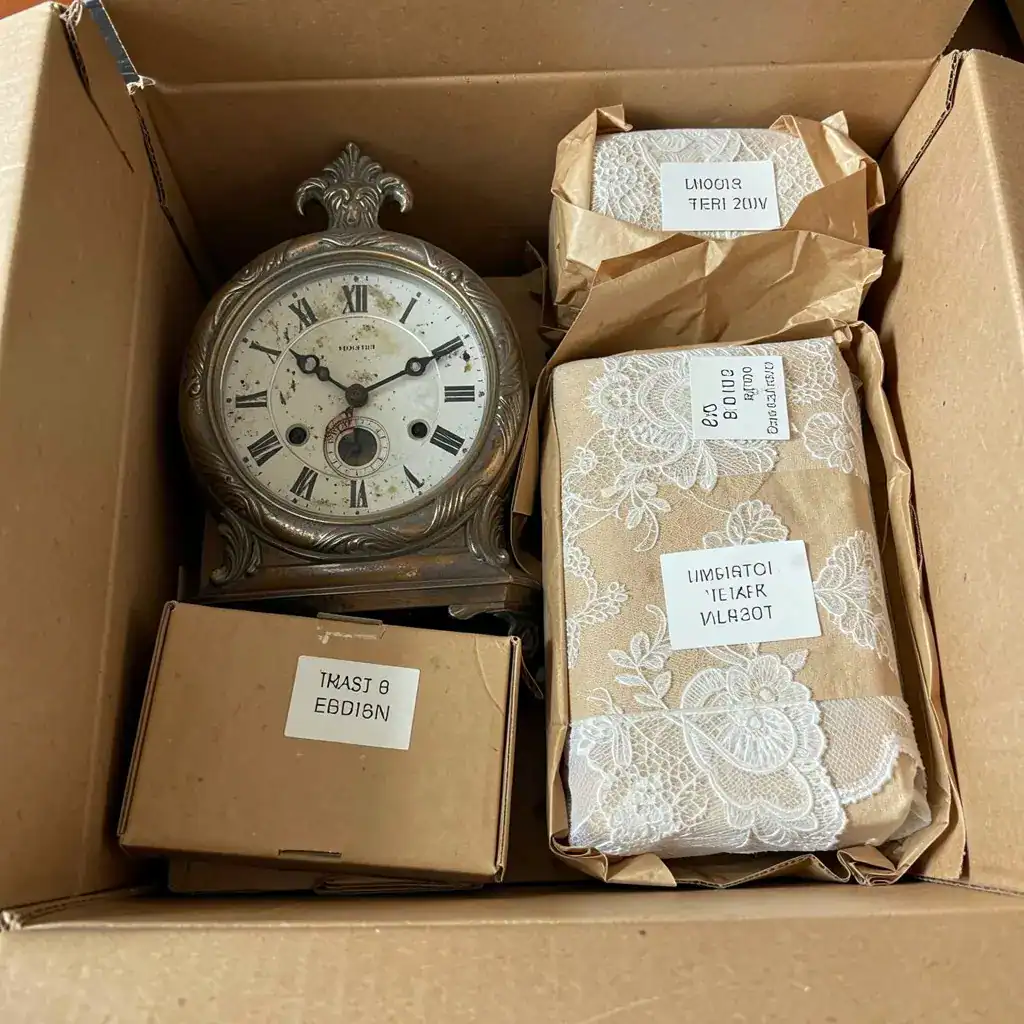
Acid-free tissue paper is the correct first contact layer for all finished wood, veneer, lacquered, gilded, and painted surfaces. Acid-free tissue is pH neutral — it contains no wood pulp acids that degrade organic finishes over time — and its smooth surface does not abrade even the most delicate shellac or oil finish. Wrap the entire finished surface area of the piece with a complete layer of acid-free tissue before adding any other packing material. For veneer surfaces with visible lifting edges, run a strip of acid-free tissue paper under the lifted edge as a separator layer before wrapping — this prevents the lifting edge from catching on moving blankets and extending the veneer separation during packing and unpacking.
Unbleached cotton muslin — available by the yard from fabric suppliers — is an alternative first contact layer for upholstered antique pieces where the textile surface cannot tolerate the friction of tissue paper during a long transit. Muslin is breathable, chemically neutral, and gentle on aged textile fibers. It does not trap moisture against the upholstery the way plastic does, which is critical for horsehair, wool, and silk upholstery on Victorian and Edwardian pieces that are vulnerable to mold under sustained humidity exposure.
Moving blankets go over the acid-free tissue or muslin layer, not under it. Blankets provide the cushioning and impact absorption function — they are not surface protectors. Secure moving blankets with packing tape applied tape-on-tape: fold a strip of tape over itself at the blanket edge so that the adhesive contacts only the tape, not the blanket surface, and the blanket is held by the tape collar rather than by adhesive bonding to the fabric. Never apply tape directly to any antique surface — the adhesive in standard packing tape dissolves shellac and lacquer finishes on contact and leaves residue on oil and wax finishes that requires solvent removal, which itself risks damage to the finish.
For pieces with carved or applied ornamental elements — corbels, finials, applied moldings, ormolu mounts, ceramic insets — wrap each projecting element individually in acid-free tissue and secure with a soft cotton tie before applying the outer moving blanket. Projecting elements are the primary contact point for impact damage during loading and unloading, and a blanket draped over an unwrapped carved element will abrade the high points of the carving with every vibration during transit.
Disassembly: When It Reduces Risk and When It Increases It
The decision to disassemble any component of an antique piece is not a default efficiency decision — it is a risk trade-off that must be evaluated for each specific piece and each specific component. Disassembly that was routine for modern furniture — removing legs, separating sections, sliding out drawers — carries a different risk profile for an antique because the connection points are aged hide glue joints that may not survive the force required to separate them, and because hardware on antique pieces is frequently original and irreplaceable.
Drawers should always be removed from chests, sideboards, secretaries, and case furniture before moving. A drawer left in its case during transport adds weight at the worst structural position — high and forward — and shifts in its opening during every road irregularity, applying repeated impact to the drawer dividers and case interior. Remove each drawer, wrap it individually in acid-free tissue and a moving blanket, and transport it in a separate padded box or on a flat protected surface in the truck. Label each drawer with its position — top left, middle center — and photograph its position before removal so reassembly restores the original fit. Antique drawer boxes are frequently sized individually to their specific openings and are not interchangeable.
Leaves from dining tables should be removed and transported separately in padded flat carriers. Table legs that unscrew cleanly can be removed if the thread is in good condition, but forcing a leg that has seized in its socket risks splitting the socket or the leg tenon. If a leg does not turn freely by hand, leave it attached and wrap the table as a unit. Glass or marble table tops should always be removed, wrapped separately in multiple layers of acid-free tissue and moving blankets, and transported vertically — never flat — in a padded carrier or custom crate.
Doors on armoires, cabinets, and secretaries should be secured closed rather than removed, unless the piece cannot navigate its path with doors on. Secure doors with soft cotton ribbon or twine tied across the front — never with tape applied to the door frame or the door face. If the doors have working locks and original keys, lock them. If the hinges are original hand-forged or cast hardware, do not attempt to remove them — original hardware is a significant component of an antique piece’s value and authenticity, and stripped or damaged original hardware cannot be replaced equivalently.
Custom Crating: Which Pieces Require It and What It Involves
Custom crating is not a premium service for every antique — it is the correct solution for a specific subset of pieces where the form, fragility, or value exceeds what professional soft wrapping can reliably protect. The pieces that belong in custom crates are those where a failure mode during transport would be irreversible: marble-topped console tables, where the marble slab is both heavy and brittle and cannot be wrapped into a stable package without rigid containment; large ornate mirrors with gilded frames, where the frame’s projecting elements cannot be protected by wrapping alone; secretary desks with fall-front writing surfaces, where the fall-front mechanism involves aged hinges and stays that are vulnerable to any flexing of the carcass; grandfather clocks, whose movement, pendulum, weights, and hood are separate components requiring individual containment within a rigid outer shell.
A custom crate is a wooden box built to the precise external dimensions of the wrapped piece, with an internal padding system — typically foam-in-place, cut polyethylene foam, or archival tissue wadding — that immobilizes the piece completely within the crate. The piece does not move inside the crate. Any movement — any gap between the piece and the internal padding — becomes a potential impact event every time the truck brakes or turns. The gap tolerance in a correctly built custom crate is zero.
Custom crating is a specialist skill. The crate must be built from materials that will not off-gas compounds that react with antique finishes — untreated pine is generally acceptable; oriented strand board is not, because its adhesive binders can off-gas formaldehyde under heat conditions in a truck. The crate must be sized correctly — undersized crates compress the piece, oversized crates allow movement. The internal padding system must not trap moisture against the piece surface. For pieces with ivory, bone, or tortoiseshell inlays, the crating must provide climate buffering as well as physical protection, because these materials crack under rapid temperature change.
Loading Sequence and Truck Placement
Antique furniture loads last and unloads first. The principle — last on, first off — exists because loading first places antique pieces at the deepest point of the truck where they are inaccessible for monitoring, where other cargo loaded after them can shift toward them during transit, and where they must be unloaded around before the rest of the truck contents can be cleared. Loading last ensures antiques are visible, accessible, and that no cargo is stacked or positioned in contact with them during transit.
Position antique pieces upright in the orientation they are designed to inhabit — chairs upright, tables on their legs if space permits, case furniture standing. Pieces transported on their side or inverted transfer load through surfaces and joints not designed to bear it. A chest of drawers transported on its back places the full weight of the piece on the back panel, which is typically the thinnest and least structurally robust surface on the case.
Do not stack anything on top of wrapped antique furniture. The crushing load of even a lightweight box placed on a wrapped piece for hours of transit compresses the padding into the surface below, and any projecting element — a handle, a carved detail, a veneer edge — becomes the point where that load concentrates. Use furniture dollies under heavy case pieces to move them within the truck without dragging. Dragging any antique piece, even a few inches on a blanket, applies lateral load to the legs that aged hide glue joints cannot reliably absorb.
Climate Exposure During a Portland-Area Move
Portland’s climate creates a specific risk window for antique wood furniture that is distinct from drier regions. Solid wood furniture expands as it absorbs ambient moisture and contracts as it releases it — this movement is normal and manageable when the change is gradual over days or weeks. When furniture is moved from a climate-controlled interior directly into a Pacific Northwest winter exterior for loading, the surface temperature differential between the interior of the piece and the ambient air can be 40°F or more. This thermal shock causes the outer wood fibers to contract rapidly while the interior remains at the original temperature, creating internal stress that propagates along the grain and can cause checking — small surface cracks along the grain lines — in vulnerable areas such as carved details, thin panels, and veneer edges.
Minimize exposure time during loading. Pre-position the truck as close to the exit point as possible. Move pieces through the exterior transition quickly and into the truck, where the ambient temperature is more stable than the outdoor air. For pieces of exceptional value or sensitivity, schedule the move for mild-weather conditions — late spring or fall — when the temperature differential between interior and exterior is smallest.
If any antique furniture requires a storage period between the origin and destination — whether due to a lease gap, a renovation delay, or a staged move — climate-controlled storage in Portland is the only appropriate intermediate environment for antique wood, veneer, upholstery, and gilt surfaces. Standard self-storage units in the Portland area cycle through the full ambient humidity range across seasons, which subjects antique wood to repeated expansion and contraction cycles that accelerate joint failure, veneer lifting, and finish checking over any storage period exceeding two to three weeks.
Insurance: What Standard Moving Coverage Does Not Cover for Antiques
The Released Value Protection that moving companies provide at no additional charge reimburses damaged items at $0.60 per pound. A 40-pound antique side table appraised at $4,000 is reimbursed at $24 under Released Value Protection if it is destroyed in transit. This coverage is structurally incompatible with antique furniture of any meaningful value. Full Value Protection — which requires the mover to repair, replace, or pay current market replacement value for damaged items — is the minimum appropriate coverage for antiques, and even Full Value Protection carries a threshold above which the mover’s liability caps. Verify the per-article liability limit in the Full Value Protection agreement before the move.
For pieces appraised above that threshold — which for significant period furniture can be in the tens of thousands of dollars — supplemental insurance through a fine arts and valuables rider on your homeowner’s policy, or through a standalone fine arts insurance policy, provides coverage that reflects the actual appraised market value of the piece. This coverage requires the written appraisal discussed earlier. Without the appraisal, the insurance carrier cannot establish the pre-move value and the claim is settled at a generic replacement cost that does not reflect period furniture pricing.
Our guide on how to choose a moving company covers the specific questions to ask about Full Value Protection, per-article liability limits, and the Certificate of Insurance documentation process — all of which apply directly to moves involving antique and heirloom furniture.
Unpacking and Post-Move Acclimation
Do not unwrap antique furniture immediately at the destination. Allow wrapped pieces to sit in the new interior environment for a minimum of two to four hours before removing packing materials. This acclimation period allows the wood to begin equalizing with the new environment’s temperature and humidity before the protective wrapping is removed, reducing the surface stress caused by the transition.
Unwrap each piece on a clean padded surface with sufficient space to lay the packing materials flat without dropping them onto the piece. Cut tape with scissors rather than pulling it — pulling tape from moving blankets can generate enough force to dislodge loosely bonded tape collars that were in contact with delicate surfaces. Remove acid-free tissue last, after all moving blankets are clear, and inspect the surface as the tissue comes free rather than pulling it back in a single motion.
Check every piece against the pre-move photographs immediately after unwrapping and before signing any moving documentation. Any new damage — scratches, veneer lifts, finish marks, joint separations — must be documented in writing on the delivery paperwork and photographed before the crew leaves. Once the delivery documentation is signed without noted damage, the claim window for transit damage effectively closes.
Allow antique furniture to acclimate fully to the new environment before reassembling any disassembled components, applying any polish or wax, or placing objects on surfaces. Drawers should not be forced into their cases if they swell slightly in a more humid environment — allow them to equalize for 24 to 48 hours before fitting them. If any joint has loosened during the move, consult an antique furniture conservator rather than applying modern wood glue to a hide glue joint. Modern PVA and polyurethane adhesives are not compatible with hide glue joints and can prevent proper restoration by a conservator if the repair is undertaken incorrectly.
If you are coordinating a full residential move in the Portland or West Linn area that includes antique or heirloom furniture alongside a full household, communicating the antique inventory to the crew before the move begins establishes the loading sequence, wrapping protocol, and truck placement before the day starts — not after the furniture is already on the floor.
For local moves throughout Portland and the surrounding area, Redefyne Moving & Storage handles antique and heirloom pieces with the material selection and handling approach the items require. If your move includes pieces that need packing support, our packing services extend to specialty wrapping for furniture that cannot be safely packed with standard moving materials. Get in touch for a free quote today.