Mirrors are among the most stressful items to move. They’re heavy, awkward to carry, and devastatingly easy to break. Whether you’re dealing with a large bathroom vanity mirror, a decorative wall mirror, or a full-length standing mirror, improper packing is the number one cause of damage during a move.
The good news? With the right materials, a bit of patience, and a step-by-step approach, you can pack mirrors safely and get them to your new home in one piece. This guide walks you through everything — from gathering supplies to loading the moving truck.
If you’d rather leave the heavy lifting (and careful wrapping) to the pros, our Portland movers are experienced in safely handling fragile items of every size.
Why Mirrors Break During Moves — and How to Prevent It
Before jumping into the how-to, it helps to understand why mirrors break in the first place. Most mirror damage during a move isn’t caused by a single catastrophic drop. Instead, it usually comes from one of these common mistakes:
- Laying the mirror flat in the truck, allowing weight to press down on the glass
- Stacking boxes on top of a mirror
- Not using enough padding or cushioning
- Leaving the mirror loose so it can shift and vibrate during transport
- Placing the mirror against a hard, unpadded surface
Understanding these risks makes it much easier to pack correctly. The goal is always to keep the mirror upright, fully cushioned, and immobilized throughout the move.
What You’ll Need to Pack a Mirror
Gather all your supplies before you start packing. Running out of bubble wrap mid-wrap is a recipe for a poorly protected mirror. Here’s what you need:
Essential Supplies
- Packing tape (heavy-duty) — standard tape won’t hold under pressure
- Painter’s tape or masking tape — for creating an X across the glass surface (more on this below)
- Bubble wrap (large sheets) — the primary cushioning layer
- Packing paper or newsprint — for the first protective layer against scratches
- Mirror box or picture frame box — a flat, telescoping box designed specifically for mirrors and artwork
- Moving blankets or furniture pads — for extra protection and loading
- Corner protectors — foam or cardboard corners guard against the most vulnerable points
- Permanent marker — for labeling the box clearly
Mirror boxes are available at most moving supply stores and online. If you can’t find one, a double-walled cardboard box that closely fits the mirror can work in a pinch — but a proper mirror box is always the better choice.
Step-by-Step: How to Pack a Mirror for Moving
Step 1: Tape an X Across the Mirror Glass
Before wrapping anything, use painter’s tape or masking tape to form a large X across the entire face of the mirror, and then tape around the outer edges. This does two important things: it reinforces the glass so that if it does crack, the pieces stay together rather than shattering everywhere, and it prevents direct contact between other materials and the reflective surface.
Don’t use duct tape or heavy packing tape directly on the mirror. The adhesive can damage the reflective coating and leave a residue that’s nearly impossible to clean off.
Step 2: Wrap the Mirror in Packing Paper
Lay several sheets of packing paper on a flat surface and place the mirror face-down on top. Wrap the paper around the mirror like you’re wrapping a gift, folding the edges in neatly. This first layer protects the mirrored surface from scratches during the wrapping process.
Secure the paper with packing tape — not directly on the glass, but on the paper itself.
Step 3: Wrap With Bubble Wrap
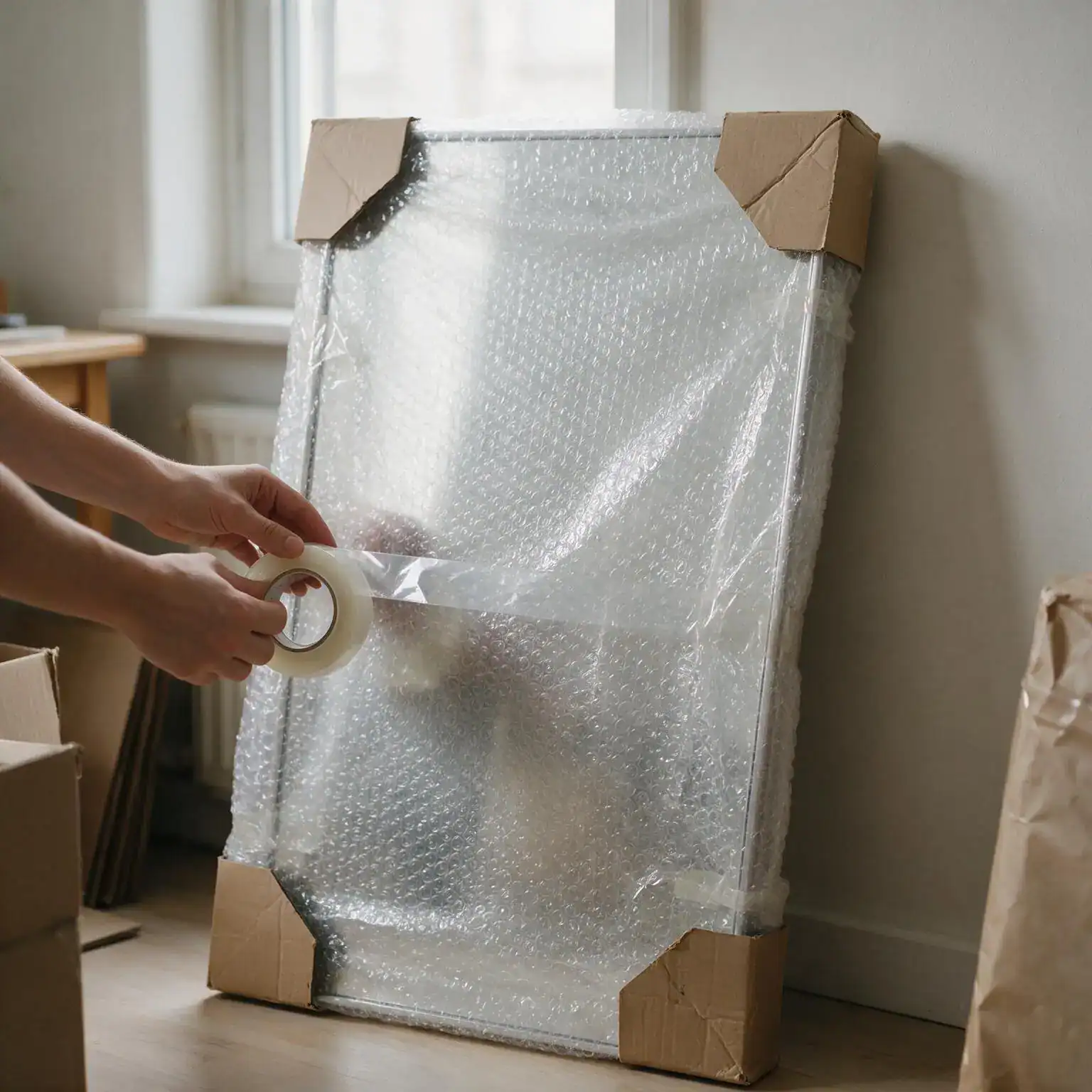
Now add your main cushioning layer. Wrap the mirror in at least two full layers of bubble wrap, making sure to cover every edge and corner. The corners are the most vulnerable points on any mirror — they chip and crack far more easily than the flat surface.
Pay extra attention to the top and bottom edges, and wrap those corners snugly. Secure the bubble wrap with packing tape.
Step 4: Add Corner Protectors
Even with bubble wrap, it’s worth adding foam or cardboard corner protectors. Slide one onto each corner of the wrapped mirror. These absorb impact energy directly at the points most likely to take a hit if the mirror is bumped or dropped at an angle.
Tape the corner protectors in place so they won’t slide off during handling.
Step 5: Place the Mirror in a Mirror Box
Assemble your mirror box and line the bottom with a layer of bubble wrap or crumpled packing paper for additional cushioning. Carefully slide the wrapped mirror into the box. If there’s any empty space around the mirror, fill it with crumpled packing paper, foam peanuts, or additional bubble wrap. The mirror should not be able to shift around inside the box at all.
If the mirror is too large for any standard box, you can create a custom cardboard sandwich by cutting two pieces of thick cardboard slightly larger than the mirror and taping them together with the mirror wrapped snugly between them.
Step 6: Seal and Label the Box
Seal the box thoroughly with several strips of heavy-duty packing tape — along all seams and across the top and bottom flaps. A well-sealed box holds its shape under pressure, which keeps the mirror better protected.
Label every side of the box clearly with:
- FRAGILE
- THIS SIDE UP
- Mirror — Do Not Stack
- Room destination (e.g., “Master Bedroom” or “Bathroom”)
The labeling isn’t just for your movers — it’s a reminder for anyone who handles the box, including yourself.
How to Pack Different Types of Mirrors
Bathroom Vanity Mirrors
Most bathroom mirrors are mounted directly to the wall rather than framed as a separate piece. If yours is a separate framed mirror that can be removed, follow the steps above. If it’s a mirror glued to the wall or part of a medicine cabinet, the process is more complex. Glued mirrors should be removed carefully — ideally by a professional — to avoid cracking during removal. Medicine cabinets should be taped shut, wrapped in moving blankets, and transported as a single unit.
Full-Length Standing Mirrors
Free-standing floor mirrors can be tricky because of their height. For these, wrap the mirror portion following the same steps above, then disassemble the stand if possible. Transport the mirror section in a mirror box or between padded moving blankets, keeping it vertical at all times. Never lay a full-length mirror flat in a moving truck.
Framed Decorative Wall Mirrors
Decorative mirrors with intricate frames need special attention. The frame itself can be fragile — carved wood, ornate metal, or resin frames can chip and break just as easily as the glass. Wrap the frame with extra padding, paying attention to any protruding decorative elements. Consider wrapping specific details individually with tissue paper or packing paper before adding the bubble wrap layer.
Antique and Oversized Mirrors
For very large or antique mirrors, professional packing is strongly recommended. Antique mirrors often have thin, aged glass that is more brittle than modern glass, and their value makes the risk of DIY damage not worth taking. Our moving services include professional packing for high-value and oversized items.
Loading Mirrors onto the Moving Truck
Even the most carefully packed mirror can break if it’s loaded incorrectly. Here are the key rules for loading mirrors safely:
Always Transport Mirrors Vertically
This is the single most important rule. Mirrors should stand on their edge — never flat. When a mirror lies flat, any weight placed on top creates pressure across the entire glass surface, dramatically increasing the risk of cracking. Standing vertically, the mirror distributes pressure along its strongest axis (the edges) and is far less likely to break from incidental contact.
Lean Against a Solid Surface
Place the mirror box against the wall of the truck or van. If possible, sandwich it between two mattresses or large furniture items with flat surfaces. The goal is to prevent the mirror from tipping over or shifting during transit.
Don’t Stack Anything on Top
Even a light box placed on top of a vertical mirror can concentrate enough pressure to crack the glass, especially if the truck goes over a bump. Keep the area directly above and around the mirror clear, or use it only for very lightweight, soft items like pillows or blankets.
Use Moving Blankets for Extra Protection
If you have extra moving blankets, wrap the outside of the mirror box for an additional layer of shock absorption. Tuck the blanket edges in firmly so they don’t come loose during transit.
What to Do If a Mirror Breaks
Despite your best efforts, accidents sometimes happen. If a mirror breaks during your move, follow these steps:
- Don’t panic. Take a breath and assess the situation before touching anything.
- Wear gloves and closed-toe shoes before handling broken glass.
- Don’t shake the box. If the glass has broken inside the box, shaking it can cause the pieces to shift and become even more dangerous.
- Carefully open the box and remove pieces one at a time, placing them in a puncture-resistant bag or container.
- Dispose of glass properly — wrap shards in several layers of newspaper before placing them in a trash bag, and label it so no one is surprised.
If the mirror was insured as part of your moving coverage, document the damage with photographs before disposing of anything.
Should You Hire Professional Movers for Fragile Items?
If the thought of packing and transporting your mirrors yourself feels overwhelming — or if you’re dealing with large, antique, or irreplaceable pieces — hiring professional movers is well worth the investment.
Professional movers have the experience, tools, and materials to pack fragile items correctly every time. They also carry liability insurance, so if something does get damaged, you have recourse. For a local move in the Pacific Northwest, our apartment movers team handles fragile items — mirrors, artwork, electronics, and more — with the same care you’d take yourself.
Whether you need full-service packing and moving or just help loading and unloading, having professionals involved for high-risk items like mirrors can save you the heartbreak (and cost) of a broken piece.
Quick Recap: Mirror Packing Checklist
Before you close that box, run through this checklist:
- Tape an X across the mirror face with painter’s tape
- Wrap in packing paper (first layer)
- Wrap in two or more layers of bubble wrap
- Add foam corner protectors to all four corners
- Place in a mirror box with padding filling all gaps
- Seal all seams with heavy-duty packing tape
- Label clearly: FRAGILE, THIS SIDE UP, Do Not Stack
- Transport vertically, leaning against a solid surface
- Keep the area around the mirror clear of heavy items
Final Thoughts
Packing a mirror for moving doesn’t have to be stressful. With the right materials and a methodical approach, you can protect even large, delicate mirrors through a cross-town move or a long-distance haul.
The key is to never rush. Take your time with each wrap, fill every gap, label clearly, and transport vertically. A little extra time spent packing means far less risk of walking into your new home to find a cracked mirror.
Need help making your next move seamless? Explore our full range of moving services or get in touch with our Portland movers team today. We’re here to make your move as smooth — and as stress-free — as possible.