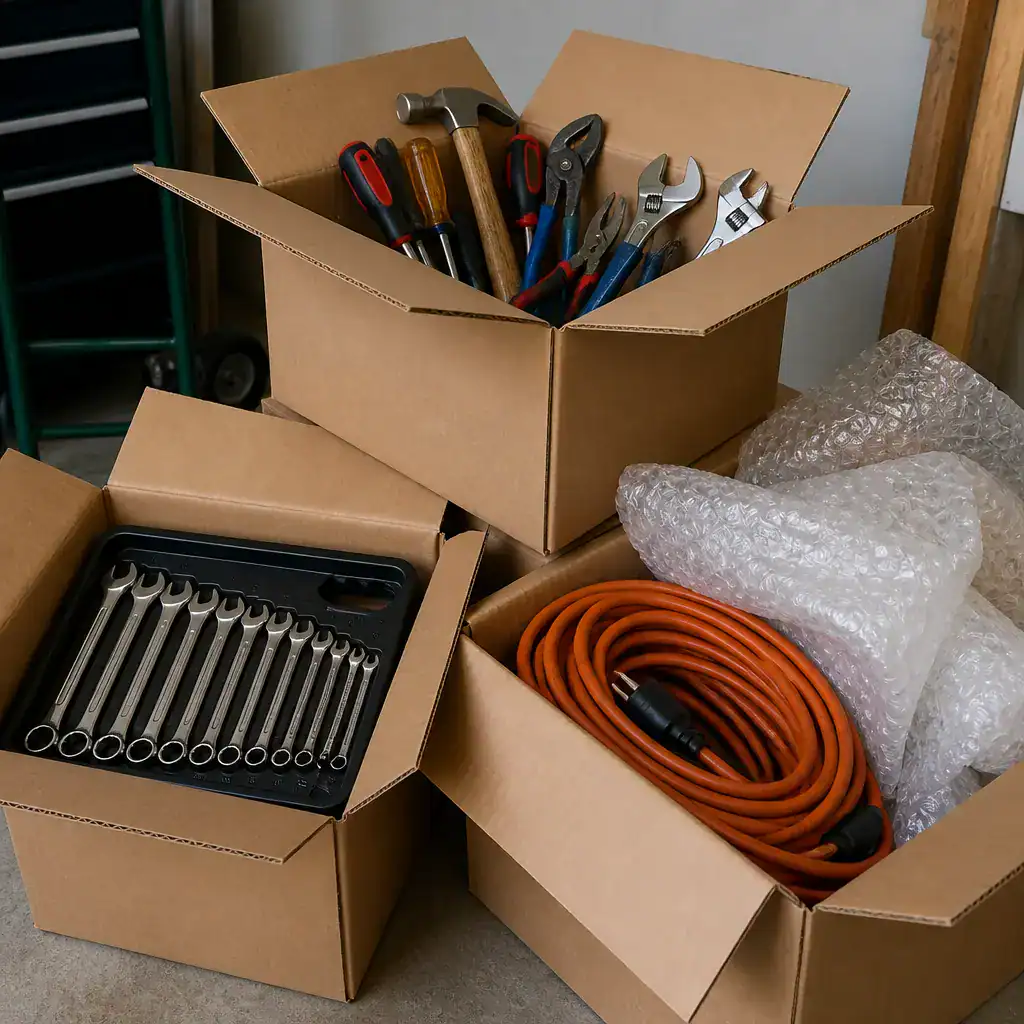
If you’ve spent years building up a tool collection, you know how quickly it adds up — both in weight and in value. Power drills, circular saws, socket sets, levels, wrenches, hammers, and everything in between. Packing tools for a move isn’t complicated, but it does require a methodical approach. Done right, your tools arrive organized, undamaged, and ready to use. Done wrong, you end up with a box of tangled cords, rust-prone metal, and blades that have punched through cardboard and damaged everything around them.
This guide walks you through exactly how to pack tools for moving — hand tools, power tools, sharp tools, and everything in the garage — safely and efficiently.
If you’re planning a move in the Portland area and want professionals who handle every item with care, our Portland movers are ready to help make moving day smooth from start to finish.
Before You Pack: Declutter Your Tool Collection
A move is the perfect opportunity to take stock of what you actually use. Before packing a single tool, go through everything and sort into three piles:
- Keep — tools you use regularly or would need to replace
- Donate or sell — duplicates, tools you haven’t touched in years, or items in poor condition
- Dispose — broken tools, worn-out blades, and anything beyond repair
Moving fewer tools means fewer boxes, less weight, and less unpacking on the other end. It’s worth spending an hour on this step before anything else.
Step 1: Clean and Dry All Tools Before Packing
Metal tools rust. If you pack tools that are dirty, oily, or damp and then seal them in boxes for days or weeks, you’re creating ideal conditions for rust and corrosion.
Before packing:
- Wipe down all metal surfaces with a clean dry cloth
- Apply a light coat of machine oil to metal hand tools and saw blades to prevent rust during transit
- Clean sawdust and debris out of power tools, especially vents and moving parts
- Let everything dry completely before packing — never pack damp tools
This step takes a little extra time but protects tools that may have cost hundreds of dollars to replace.
Step 2: Drain Fluids From Power Equipment
Any tool or equipment that uses fuel, oil, or other fluids must be drained before moving. This includes:
- Gas-powered tools — lawn mowers, chainsaws, generators, leaf blowers, and pressure washers
- Air compressors — drain the tank completely and release all pressure
- Wet/dry vacuums — empty and dry the canister
Transporting tools with fuel in them is a fire hazard and, in many cases, against the terms of your moving company’s policy. Drain all fluids at least 24 hours before the move to allow residual fuel to evaporate. Check with your moving company about their specific policies on fuel-powered equipment — our moving services team can advise you on what to prepare.
Step 3: Disassemble What You Can
Reducing tools to their smallest footprint makes them easier to pack, protects attachments, and reduces the chance of damage during transit.
- Remove drill bits, saw blades, and attachments from power tools and pack them separately
- Detach handles from tools where possible (some sledgehammers, for example, have removable handles)
- Coil power cords loosely and secure with velcro ties or zip ties — never wrap cords tightly around the tool body, as this stresses the cord and can damage the connection at the base
- Remove batteries from cordless tools and pack them separately in a cool, dry location
Step 4: Pack Sharp and Dangerous Tools First
Sharp tools — chisels, utility knives, saw blades, drill bits, box cutters — deserve special attention. An exposed blade inside a moving box is a safety hazard for anyone who opens it.
Options for Packing Sharp Tools:
- Original cases and sheaths — the best option if you still have them
- Blade guards — many saws and chisels come with plastic guards; use them
- Wrap individually in newspaper or packing paper and secure with tape so the wrapping can’t unravel
- Use a purpose-built tool roll for chisels, screwdrivers, and smaller hand tools
- Place blades in a dedicated box clearly labeled “SHARP — Open With Care”
Never toss loose blades or sharp tools into a box with other items. Even through cardboard, an exposed blade can cause injury.
Step 5: Choose the Right Boxes
Tools are heavy. Standard moving boxes will buckle and fail under the weight of a full set of hand tools or a heavy power tool. Use:
- Small, sturdy boxes for hand tools and hardware — the smaller the box, the more manageable the weight
- Double-walled boxes for power tools and anything particularly heavy
- Original manufacturer boxes for power tools when available — they’re designed to protect that specific tool and often include foam inserts
- Toolboxes and tool chests — if you already own a toolbox, use it. Pack hand tools directly in the toolbox and move it as a unit
A general rule: if a box of tools is too heavy to lift comfortably with two hands, it’s too heavy. Repack and split the weight between two boxes.
Step 6: Pack Hand Tools
Hand tools — hammers, screwdrivers, wrenches, pliers, levels, tape measures — are the workhorses of most tool collections. Here’s how to pack them efficiently:
- Group by type and size — wrenches together, screwdrivers together, and so on. This makes unpacking and reorganizing far easier.
- Wrap metal tools individually in packing paper or newspaper to prevent them from scratching each other and to provide a small amount of cushioning
- Place heavier tools at the bottom of the box and lighter tools on top
- Fill gaps with crumpled packing paper so tools don’t shift during transit — shifting tools bang against each other and against the box walls
- Don’t overfill — the box should close flat without bulging
For long-handled tools like rakes, shovels, brooms, and hoes, don’t try to force them into boxes. Bundle them together with rope or moving straps and move them as a group, or use wardrobe boxes that have the height to accommodate them standing upright.
Step 7: Pack Power Tools
Power tools require more care than hand tools because of their size, weight, and mechanical components.
- Use original boxes whenever possible. If you’ve kept the boxes your drill, circular saw, or jigsaw came in, now is the time to use them. The foam inserts are custom-fit for the tool.
- If you don’t have the original box, wrap the power tool in two layers of bubble wrap, paying extra attention to the motor housing, switches, and any protruding parts.
- Place the wrapped tool in a sturdy, snug-fitting box with padding on all sides — top, bottom, and around the edges.
- Pack batteries and chargers separately in a padded bag or box. Lithium-ion batteries should be stored at room temperature and kept away from heat during the move.
- Coil cords loosely and pack them in the same box as the tool they belong to, clearly labeled.
Label each power tool box with the tool name so you can find what you need quickly when unpacking.
Step 8: Pack Your Hardware
Screws, nails, bolts, anchors, and other hardware are easy to overlook until you’re at your new home trying to reassemble furniture and can’t find a single bolt. Here’s how to handle them:
- Keep hardware in its original containers wherever possible
- Use small zip-lock bags for loose hardware — label each bag with a permanent marker
- Tape bags to the item they belong to if the hardware is specific to a piece of furniture or equipment being disassembled for the move
- Pack all hardware in a single small, clearly labeled box so it’s easy to locate on unpacking day
Losing hardware is one of the most frustrating parts of moving. A few minutes of careful organization here saves hours of searching later.
Step 9: Moving Your Toolbox or Tool Chest
If you have a rolling tool chest, it needs special treatment:
- Empty all drawers before moving. A fully loaded tool chest can weigh several hundred pounds and the drawers will slide open during transit, potentially causing injury or damage.
- Pack drawer contents in labeled boxes or bags corresponding to each drawer so reorganizing is straightforward
- Tape or strap all drawers shut so they can’t slide open during handling and transit
- Use an appliance dolly to move the tool chest — never drag it
- Protect the wheels and casters — wrap them in tape or plastic to keep them clean during the move
For heavier tool chests, having professional movers handle this step is well worth it. Our apartment movers regularly handle heavy, wheeled items and know how to load them safely without damaging floors or the chest itself.
Step 10: Label Everything Clearly
Tool boxes should be labeled with:
- Contents (e.g., “Hand Tools — Wrenches & Pliers,” “Power Tools — Drill & Jigsaw”)
- HEAVY on any box that weighs more than 30–40 pounds
- SHARP — Open With Care on any box containing blades or pointed tools
- Destination room — most tools will go to a garage, workshop, or utility room
Clear labeling means movers know how to handle each box, and you can find what you need without opening every single box on the first day.
What Not to Pack With Tools
Keep tools in their own boxes, separate from:
- Household cleaners and chemicals — spills can corrode metal and damage tool components
- Electronics — tools are heavy and will crush or damage electronics if packed together
- Clothing or linens — tool grease and oil will stain fabric
- Food items — for obvious reasons
Tools are best consolidated in a dedicated area of the moving truck, away from fragile and soft items.
Quick Checklist: Packing Tools for Moving
- Declutter — donate, sell, or dispose of tools you no longer need
- Clean and dry all tools thoroughly
- Apply light machine oil to metal surfaces to prevent rust
- Drain all fuel and fluids from gas-powered equipment
- Remove batteries from cordless tools
- Disassemble tools and pack attachments separately
- Wrap sharp tools individually and label boxes “SHARP”
- Use small, sturdy boxes — never overload
- Pack hand tools by type and fill gaps with packing paper
- Use original boxes for power tools where available
- Bag and label all loose hardware
- Empty and tape shut all toolbox drawers
- Label every box: contents, weight warning, destination room
Final Thoughts
Packing tools for moving is really about three things: safety, organization, and protection. Sharp tools packed carelessly are a hazard. Disorganized tool boxes mean hours of frustration unpacking. Metal tools packed without preparation come out rusty and damaged.
Take the time to do it right — clean everything, wrap sharp items carefully, use the right size boxes, and label clearly. Your tools will arrive ready to use, and your first project at the new place won’t be hunting down a missing wrench.
If you’re planning a move in the Portland area and want a team that handles every item — from fragile glassware to heavy tool chests — with the same level of care, get in touch with our Portland movers today. We’ll take the heavy lifting off your hands.