A refrigerator is the heaviest kitchen appliance in most homes, the most technically sensitive to incorrect handling, and one of the few items in a household move where a single procedural error — laying it flat for too long, plugging it in too soon, or skipping the defrost window — can produce a failure that is not immediately apparent but becomes permanent within days of use. Before addressing how to move a refrigerator, the more consequential question is whether moving it is the rational choice given the specific circumstances of the move. That decision depends on the age of the appliance, the configuration of the new home, and the cost of moving it relative to the cost of replacing it.
The Decision to Move, Replace, or Leave the Refrigerator
A refrigerator over 10 to 15 years old carries a compressor that has already absorbed the majority of its operational lifespan. The average hermetically sealed compressor in a residential refrigerator is designed for approximately 10 to 20 years of continuous operation depending on the manufacturer and usage pattern. A unit approaching the upper end of that range that requires the stress of disconnection, transport, and reconnection during a move is a higher risk for compressor failure than a unit that remains stationary. The cost-benefit calculation for moving an aging refrigerator is straightforward: if the appliance would require replacement within two to three years regardless, the combined cost of moving it — labor, truck weight, double-handling if storage is involved — may exceed the cost of leaving it and purchasing a new entry-level unit at the destination.
Many Portland-area rental properties include a refrigerator as a fixed appliance. If the new home provides a refrigerator and the existing one has no clear use at the destination, moving it creates a logistics problem rather than solving one. Surplus appliances stored in a garage or basement accumulate cost without function. Appliance disposal in Oregon requires refrigerant evacuation by an EPA Section 608-certified technician before the unit can be accepted at a Metro Portland transfer station, which adds both cost and scheduling complexity to the disposal process.
For refrigerators under 10 years old moving to a home without an appliance, or for high-end units — French door refrigerators, counter-depth models, or smart refrigerators with integrated display panels — where the replacement cost significantly exceeds the moving cost, relocation is the correct decision and the remainder of this guide applies directly.
Why Upright Transport Is a Physical Requirement, Not a Preference
The compressor in a household refrigerator contains a reservoir of synthetic or mineral oil that lubricates the piston and cylinder assembly during operation. In the upright position, this oil sits in the compressor sump — the lowest point of the sealed compressor housing — held there by gravity. When the refrigerator is laid on its side or back, gravity redistributes the oil out of the sump and into the refrigerant lines that connect the compressor to the evaporator and condenser coils.
These refrigerant lines are designed to carry refrigerant vapor and liquid, not oil. When oil enters the lines and partially blocks them, the compressor must work against increased back pressure to push refrigerant through the system. In severe cases, oil blocks the capillary tube or expansion device entirely, stopping refrigerant circulation and causing the compressor to run continuously without producing cooling — a failure mode that generates enough heat to burn out the compressor motor within hours of operation.
The waiting period after a move — three to four hours if the refrigerator was transported upright throughout, and a minimum of 24 hours if it was tilted beyond 45 degrees or laid on its side — allows gravity to drain the migrated oil back into the compressor sump before the unit is powered on. This waiting period is not a manufacturer formality. It is the physical time required for oil of a given viscosity to flow through the narrow refrigerant tubing back to the sump under gravity alone. Plugging in a refrigerator that was transported on its side without waiting causes the compressor to run with oil-logged lines — the most common cause of irreversible post-move compressor failure.
If the refrigerator must be transported at an angle due to vehicle height constraints, lay it on its side rather than on its back or front. The compressor in most residential models is mounted at the lower rear of the cabinet. Laying the unit on either side places the compressor approximately parallel to the floor, which limits but does not eliminate oil migration. Laying it on its back or front places the compressor sump directly adjacent to the refrigerant lines, maximizing oil migration. Consult the manufacturer’s manual for the specific model to confirm which side the compressor is mounted on — in most models, the compressor is offset to the right when facing the rear of the unit, making the left side the slightly safer transport orientation.
Preparation: The 24 to 48-Hour Window Before Moving Day
Unplug the refrigerator 24 to 48 hours before the physical move. This window serves two distinct functions: it initiates defrosting of the freezer compartment and allows the compressor oil and refrigerant to stabilize at ambient temperature and pressure before transport.
The term “frost-free” on modern refrigerators refers to an automatic defrost cycle that periodically melts accumulated frost during normal operation — it does not mean the freezer contains no frost or ice at any given time. A frost-free freezer compartment that has been running normally will still have residual frost on the evaporator coil and ice in the ice maker assembly when powered down. Manual defrost models will have substantially more. In both cases, 24 hours of open-door defrosting at room temperature, with towels placed at the base of the unit to absorb melt water, is the minimum preparation window. Moving a refrigerator with residual ice creates melt water that soaks surrounding materials during transport and saturates the insulation between the liner and cabinet walls, where it cannot fully evaporate.
After defrosting, dry every interior surface thoroughly, paying specific attention to door gaskets, crevice points around the liner edges, and the drip channel at the base of the freezer compartment. Any residual moisture trapped in these areas will produce mold and odor during the sealed transport period.
Disconnect the water supply line if the refrigerator has an ice maker or water dispenser. Locate the shutoff valve — typically under the kitchen sink or behind the refrigerator on the wall — and close it before disconnecting the supply line at the refrigerator’s inlet fitting. Drain the residual water from the disconnected line into a towel or bucket, then seal both the wall-side fitting and the refrigerator inlet with a zip-lock bag secured with a rubber band to prevent dripping during the move. Empty the ice bin completely and remove it from the unit for separate transport.
Remove all interior glass shelves, plastic crisper drawers, and door bins before moving. Glass shelves are the most fragile interior components — they are vulnerable to both impact damage and thermal shock from temperature changes during transport — and they add unnecessary weight that destabilizes the load on the appliance dolly. Wrap each glass shelf individually in moving blankets or bubble wrap and transport them in a separate padded box.
Spatial Measurement and Door Removal
Measure the refrigerator’s height, width, and depth including handles before attempting to move it. Standard French door and side-by-side refrigerators range from 35 to 36 inches wide, which approaches or exceeds the clear width of a standard 32-inch interior door frame. Most residential refrigerators allow door removal by lifting the refrigerator doors off their hinge pins after removing the hinge covers — a process that takes approximately 20 minutes per door and reduces the effective width of the unit by two to four inches on each side. This is the correct solution when clearance is marginal, not forcing the unit through a frame with millimeters of tolerance, which damages door gaskets and can crack the exterior finish.
Measure the kitchen alcove dimensions as well as the path to the moving truck. A refrigerator that fits in the alcove may not fit through the hallway at the angle required to navigate from the kitchen to the front door.
Equipment and Crew Requirements
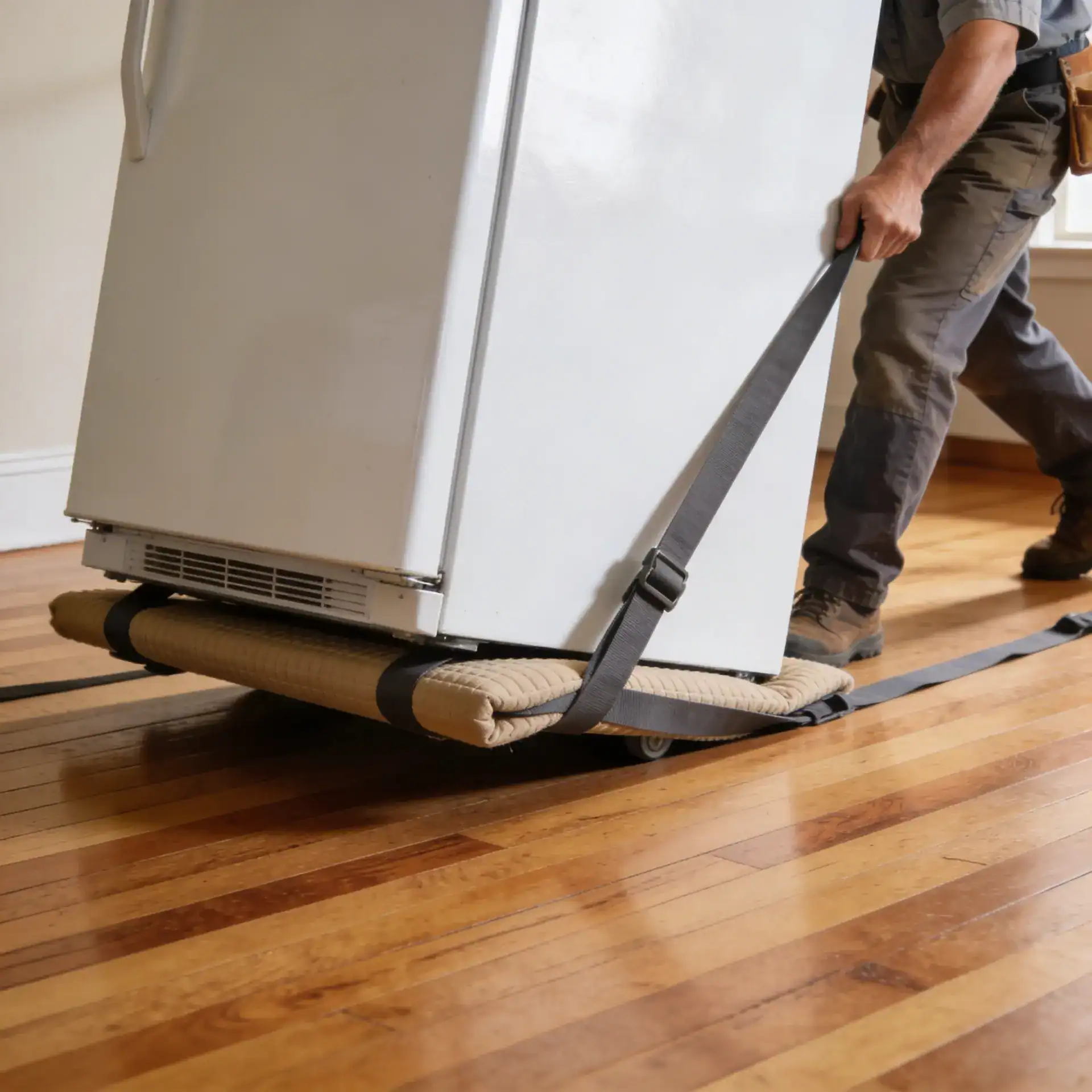
An appliance dolly — not a standard furniture dolly — is the correct equipment for refrigerator transport. An appliance dolly has a curved back plate designed to support the upright profile of a tall, heavy appliance, integrated securing straps, and a two-wheel configuration with a stair-climbing nose plate for navigating steps. A furniture dolly places the load horizontally and provides no mechanism for keeping a tall appliance upright on slopes or thresholds.
Use furniture sliders under all four corners before pulling the refrigerator away from the wall to avoid scratching hardwood or tile floors. Wrap the exterior in moving blankets secured with stretch wrap before loading onto the dolly. Secure the refrigerator doors with a bungee cord or moving strap to prevent them from swinging open during the carry.
A minimum of two people is required for any refrigerator move. Any model over 350 pounds — which includes most French door and side-by-side models — requires three people, particularly on stairs, where the person at the lower end of the carry bears the majority of the load during descent. The lower person controls the dolly, the upper person guides and stabilizes, and a third person manages doors and provides additional stability on landings.
Truck Loading and Post-Move Protocol
Position the refrigerator upright against the truck wall, as close to the cab as possible, and secure it with ratchet straps run through the truck’s tie-down rails at two points — mid-height and upper third. Do not place any item on top of the refrigerator or against the compressor housing at the rear lower section. In warm weather, minimize the time the refrigerator spends in an unventilated truck, as sustained heat exposure above 90°F accelerates refrigerant pressure changes that stress the sealed system.
At the new address, position the refrigerator in its final location before removing the straps and blankets. Adjust the leveling legs at the base of the unit until it is level front-to-back and side-to-side using a spirit level placed on the top surface. An unlevel refrigerator places asymmetric stress on the compressor mounting, accelerates door seal wear on the low side, and causes the doors to swing open or closed rather than staying in position.
Wait the full upright period — three to four hours minimum if transported upright throughout, 24 hours if the unit was tilted or laid on its side at any point — before connecting power. After powering on, allow two to three hours for the interior to reach operating temperature before restocking food. The FDA recommends a refrigerator temperature at or below 40°F before introducing perishables. Reconnect the water supply line, check all fittings for drips, and test the ice maker function before concluding the setup.
If you are moving your home and your refrigerator is one of several large appliances being relocated, coordinating the appliance disconnect timing, defrost window, and loading sequence with your moving crew before the job starts ensures that the refrigerator is ready to move when the crew arrives and loaded correctly without compressor risk.
For local moves in Portland, West Linn, and surrounding areas, Redefyne Moving & Storage brings the appliance dollies, furniture sliders, and heavy appliance experience to move your refrigerator safely from origin to destination. Reach out for a free quote today.